
Market time
CURRENT SYSTEM STATE
WORLD SIGNALS
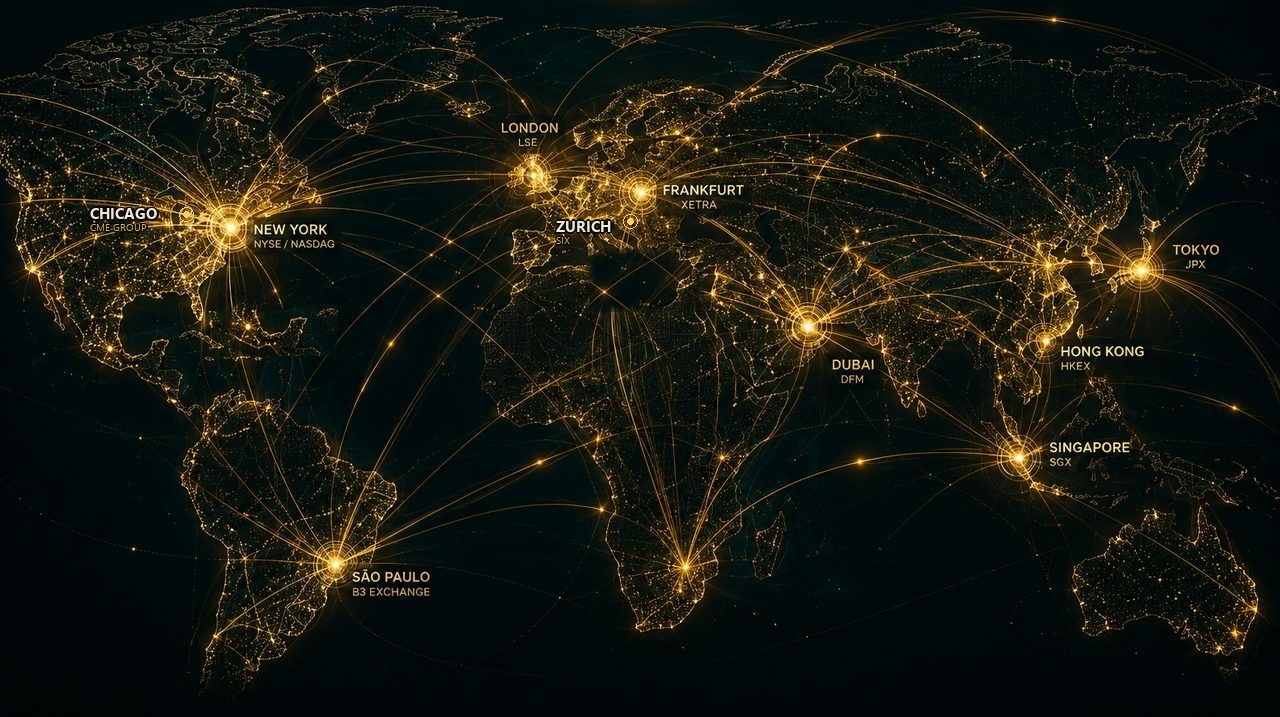
WORLD tells you what is happening. OVERVIEW tells you what matters. INTELLIGENCE explains why. CAPITAL FLOW shows where pressure is moving.
WHAT MATTERS NOW · THREE THINGS
What changed since you last visited
What to watch today
Markets · last session
Signals above threshold
Upcoming macro
Every claim carries its evidence: sample size, hit rate against baseline, whether it held in both halves of the sample, how long it has held, and what would prove it wrong. Stage is decided by the pipeline, never by hand.
Regime now
Rates & inflation
What Apex cannot say
A system that knows when it does not know. These were tested, and the answer was no.
Apex evidence · the register
Fallen findings — tested, did not hold, kept on purpose
Correlations · 60 sessions
Event studies · measured reaction after macro prints
Ask Apex · Hypothesis → Evidence → Learning
A claim enters as a hypothesis. Apex measures it, tries to disprove it, records the result, and carries the evidence forward.
A condition on closed daily bars → the target is held N days, non-overlapping; a hit is a move over break-even in the chosen direction. Baseline = same target, direction and hold, all days. Every test is logged permanently and the Bonferroni threshold is computed over the whole family: every sweep recorded in the register plus every test ever run here. Status is a printed rule — p < 0.05 is not belief. Series → metric → operator → value: the question has to become measurable before Apex answers it.
Research history · every test ever run here, kept permanently — click a row
Decision log · what Apex said, day by day
Price-based capital rotation · last session
Measured on sector ETF prices. Apex has no fund-flow data (no creations, no AUM) — a sector can rise because fewer sell, not because more buy.
Apex interpretation
Pre-event configuration · the historical test behind the pre-read
Strategic pressure · capacity → constraints
Event cycle · pre-read → outcome → next event
Leaders · single names
Today’s read · sector → hypothesis → evidence → decision
Targets · what a sector move has meant for the instruments we trade
Market character · Relative strength · Regime · Correlation · Apex decision
Confidence is the engine’s score against its own threshold — not a probability. LEANING = the evidence points more strongly toward that side than the other, but does not meet the execution threshold; Apex does not recommend the trade. Roles, defined once: ENGINE ACTIVE = the engine analyses the market and produces decisions (system status, not signal status); TRADEABLE = execution is permitted when every entry condition holds; SHADOW · NO CAPITAL = the decision counts in research, never as execution; CONTEXT = analysed for the others, never traded. Bias ≠ signal: below the trigger the engine has a lean, not a trade. Research finding ≠ trade signal: a finding influences Apex only when its activation and validation criteria are met. Each card opens with the decision and the reason, then the interpretation, then the data behind it. A direction is shown only when confidence is above its threshold; otherwise Apex waits — and says which way it leans.
APEX SELECTED EQUITIES
Not a screener. Each company is read through the same chain as the rest of Apex: strategic theme → sector flow → relative strength → regime. The decision is a printed rule, not a score. Click a row for Why this stock?
Discovery · what deserves attention
Historical regime match · what today resembles → what happened then → the dot-com stress case → scenarios → what would change the conclusion
We don’t ask whether today’s market looks like the dot-com bubble. We measure which historical regimes it actually resembles — and then test what happened next. Ten series Apex can fetch back to the 1970s are z-scored and today’s month is compared with every month-end since 1974. What Apex cannot measure that far back is listed, not guessed.
1 · What does today resemble?
2 · What actually happened in those cases?
3 · What about dot-com? · stress analogue, not closest match
4 · What scenarios follow? · what if AI follows a dot-com-like reset?
5 · What would change the conclusion?
Changes since your last visit · register
Execution scorecard
Why Apex traded · signal → reasoning → result
Open positions
Per instrument · since 26 Aug · after fees and slippage
Friction · what a trade must beat
What Apex is learning · execution by instrument
Query the trade log
Shadow rule · event-surprise brake
What Apex is
Octavian Apex is a decision-intelligence system for global markets. It reads the world — geopolitics, rates, energy, capital rotation, policy — and turns it into one structured chain: what is happening → what matters → why → where markets indicate capital is rotating → what each market is doing → which companies matter → which past regime this resembles → what could happen next → what to watch → what it means for a portfolio → what Apex itself is doing about it. Every tab on this site is one link in that decision chain.
What makes it different
Most market commentary is opinion with a chart. Apex is measurement with a rule.
- Every claim carries its sample size. Under 10 observations is labelled INSUFFICIENT DATA; under 30 is SMALL. A hit rate is always shown with its 95 % interval, because 100 % on three trades means 44–100 %.
- Findings live in a register with a stage: DISCOVERED, IN SHADOW, VALIDATED, LIVE — or FAILED. Failed findings are kept visible on purpose. Today: 49 findings, 25 marked FAILED.
- Nothing is promoted on a story. A rule runs in shadow, is measured against its own break-even, and is promoted only when the sample holds in both halves of the record.
- Apex never issues buy or sell recommendations. It shows states — ACT, WAIT, NO EDGE, CONFLICTING EVIDENCE, INSUFFICIENT DATA — and what would change each of them.
The differentiation is not a single signal or model. It is the decision architecture connecting global events, strategic pressure, capital rotation, market regimes, historical validation, scenarios, portfolio context and execution — with the same evidence framework applied throughout.
A note on capital rotation: the Capital Flow layer is price-based rotation analysis across sectors and assets. It is explicitly distinguished from fund-flow data, which Apex does not yet ingest.
The engine
Apex runs its own execution engine as a live proof-of-method environment: a 1 000-unit account on exchange prices, with the exchange’s real fee schedule and measured slippage, executed as paper until the method has earned real capital. It trades a narrow scope (Brent crude and Solana) while every other instrument is logged in shadow. Results, drawdown and every rule change are published on the EXECUTION tab. The record starts 26 August 2026 and is never rewritten — corrections are applied at read time and documented.
How Apex works — in numbers
Inputs. Apex ingests news through tiered source lists (tier-1 wires first), a calendar of 73 scheduled macro and political events, 122 daily price series, 35 research series back-filled to 2021 (32 000 observations: stablecoin supply, futures positioning, volatility, prediction-market odds), and a 1-minute price store for 12 instruments (185 000 bars and growing).
Signal load. 23 execution rules and 7 instrument-specific signal engines evaluate the feed continuously. Since launch the system has logged over 72 000 signal evaluations, 40 000 crypto-policy readings and 16 000 fake-pump checks. Roughly one evaluation in 200 becomes a trade.
How noise is removed. A headline needs source confirmation before it carries weight, and a deal-breaker headline is a confidence penalty, not a trade. Signals decay within six hours. An entry must clear the instrument’s own break-even before it is allowed; a trade against the day’s trend is penalised; positions closed by a system fault are excluded from every statistic, never deleted. Every hypothesis test is logged permanently and corrected for multiple comparisons across all tests ever run — 20 so far, most of them negative.
Backtesting, and why we distrust it. Backtests generate hypotheses; they never promote them. Every rule is measured forward, in shadow, on the live feed, against its own break-even, and split in half by date. A rule that works in one half and not the other is not a rule. Before the current record began, the engine logged 1 591 test trades between 9 June and 25 August 2026 across 12 instruments — exchange indices, crypto and energy. That period produced most of the failed findings, and it is why the scope is now narrow. Since then, 453 trades carry a measured outcome; 334 since 26 August, of which 96 count and the rest are shadow.
The register. 49 findings with a stage: 25 FAILED, 4 VALIDATED, 10 LIVE in the engine, 8 IN SHADOW, 2 DISCOVERED. Failed findings stay visible, with the reason.
Why this is hard to replicate. Not because of any single model, but because the same evidence framework runs end to end: the same break-even, the same sample-size rule, the same falsification test — from a geopolitical headline to a closed trade. 121 journal entries document every rule change and every error, with cause. The engine is 19 600 lines; the research library that makes the measurement mistakes structurally impossible is 470.
Every figure above is counted from the system’s own logs and registers, not typed.
Where it stands
Apex is in private beta. The research layer tracks 35 daily series across crypto, energy, metals, rates and prediction markets. The public WORLD tab is open to everyone; the remaining tabs, Ask Apex and the engine are for members.
For investors and partners
Apex is currently in private beta and is building toward a broader decision-intelligence platform for professional market participants.
We are open to conversations with investors and strategic partners interested in the intersection of market intelligence, statistical research, scenario analysis and systematic execution.
On request, we can share the full research record, decision journal, discovery register — including failed findings — and the underlying methodology.
Write to invest@apexgdi.com.
Octavian Apex is a research and decision-support tool. Nothing on this site is investment advice, an offer, or a solicitation. Trading leveraged instruments can result in losses exceeding deposits.
Octavian Apex · 2026